Water Well Drilling Rigs
Water well drilling rigs are used to construct boreholes for agricultural, residential, commercial and industrial groundwater supply. Riggers International manufactures and supplies water well drilling rigs in DTH, rotary and mobile configurations for different drilling depths, bore diameters and geological conditions. From compact equipment for limited-access sites to heavy-duty rigs for demanding borehole projects, the right machine configuration helps improve drilling performance, mobility and operational efficiency.
Types of Water Well Drilling Rigs
Different rig configurations are available according to drilling method, geology and site access.
Rotary Water Well Drilling Rigs
Rotary rigs use a rotating drill string and suitable drilling tools for borehole construction across compatible ground conditions.
Crawler-Mounted Water Well Rigs
Crawler rigs provide tracked mobility for uneven terrain, remote sites and locations where wheeled access may be difficult.
Truck-Mounted Drilling Rigs
Truck-mounted rigs provide practical road mobility for contractors working across multiple accessible drilling sites.
DTH Water Well Drilling Rigs
DTH rigs use compressed air and a down-the-hole hammer for drilling through hard and competent rock formations.
Compact Water Well Drilling Rigs
Compact rigs are suitable for projects where transport, manoeuvring space or site access is limited.
Applications of Water Well Drilling Rigs
Water well drilling equipment can support:
- Agricultural and irrigation wells
- Residential boreholes
- Commercial groundwater projects
- Industrial water supply
- Community water projects
- Institutional water supply
- Rural groundwater development
The suitable rig depends on the required depth, bore diameter, ground formation and drilling method.
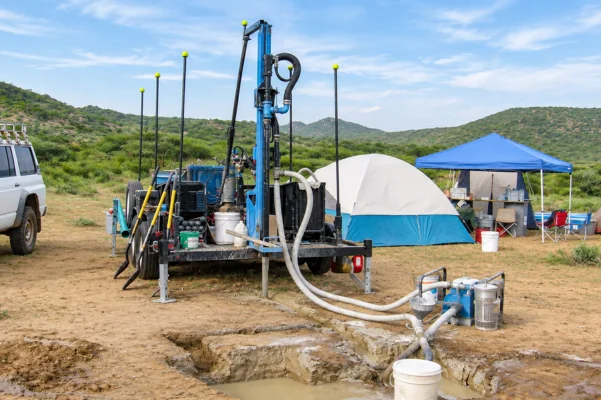
How to Select a Water Well Drilling Rig
Drilling Method
DTH drilling is commonly used in hard rock, while rotary drilling can be suitable for other formations depending on the drilling system.
Site Access
Road conditions, terrain and available working space help determine whether a truck-mounted, crawler or compact rig is more practical.
Drilling Depth
The required borehole depth influences rig capacity, drill rod configuration and lifting requirements.
Geological Formation
Soil, weathered formations, mixed ground and hard rock may require different drilling methods and tooling.
Bore Diameter
Bore diameter affects drilling tools, rotary torque, hammer size and supporting equipment.
Water Well Drilling Equipment
A drilling rig operates together with compatible supporting equipment. Supporting equipment should be matched to the selected rig, drilling method and borehole requirements. Typical requirements can include:
Drilling accessories and replacement parts
Casing equipment
Air compressors
DTH hammers
Drill bits
Drill rods
Mud pumps
Our Water Well Drilling Rig Range
Riggers International offers several water well drilling rig models for different borehole and drilling requirements.
| Model | Rig Type | Application |
|---|---|---|
| TBW 40 | Water Well Drilling Rig | Compact water well and groundwater drilling projects |
| KWD 10 | Water Well Drilling Rig | General borehole drilling applications |
| DTH-1500 | DTH Drilling Rig | Heavy-duty DTH borehole drilling |
| DTH-1500 Double | Double-Mast DTH Rig | DTH drilling requiring a double-mast configuration |
| DTHR-100 | Water Well Drilling Rig | Water well projects requiring mobility and drilling capability |
| DTHR-300 | Water Well Drilling Rig | Higher-capacity water well drilling requirements |
| DTHR-600 | Heavy-Duty Drilling Rig | Demanding water well and borehole projects |
Detailed specifications should be reviewed for the selected model before purchase.
Why Choose Riggers International?
More Than Three Decades of Experience
Riggers International has over three decades of experience in drilling equipment manufacturing and supply.
Project-Based Rig Selection
Customers can compare rigs according to drilling depth, bore diameter, geology and site requirements.
Supporting Equipment and Parts
Compatible drilling tools, spare parts and supporting equipment are available for suitable machines.
Multiple Water Well Rig Configurations
Our range includes DTH, rotary and mobile drilling rigs for different borehole requirements.
International Equipment Supply
Water well drilling equipment is supplied to customers in India and international markets.
Manufactured in India
Drilling equipment is manufactured in India for domestic and international projects.
Frequently Asked Questions
1. What is a water well drilling rig?
A water well drilling rig is a machine used to drill through soil or rock to construct a borehole and access groundwater.
2. How much does a water well drilling rig cost?
Price depends on the rig model, drilling capacity, configuration, supporting equipment and included accessories.
3. How deep can a water well drilling rig drill?
Maximum drilling depth varies according to the rig model, bore diameter, drilling method and geological conditions.
4. What is the difference between DTH and rotary water well drilling?
DTH drilling uses a pneumatic hammer and compressed air, while rotary drilling mainly uses rotation and suitable cutting tools.
5. Do water well drilling rigs require an air compressor?
DTH drilling generally requires an air compressor to operate the hammer and remove drilling cuttings.
6. Can a water well drilling rig drill through hard rock?
Yes. DTH-configured water well rigs are commonly used for hard-rock formations when matched with a suitable compressor, hammer and bit.
7. What should I check before buying a water well drilling rig?
Consider drilling depth, bore diameter, geology, drilling method, site access, rig configuration and supporting equipment.
8. Can a water well drilling rig be supplied with a compressor?
A complete equipment package can be discussed according to the selected rig model and project requirements.
9. What affects water well drilling rig selection?
The main factors are drilling depth, bore diameter, geological formation, drilling method, mobility and site conditions.