Borewell Rigs for Agricultural Applications
Choose a farm borewell rig around the geology, target depth, finished diameter, casing plan and field access, not maximum depth alone.
- Formation
- Soil to hard rock
- Published depth
- 500 ft to 1,500 ft
- Mounting
- Tractor or truck
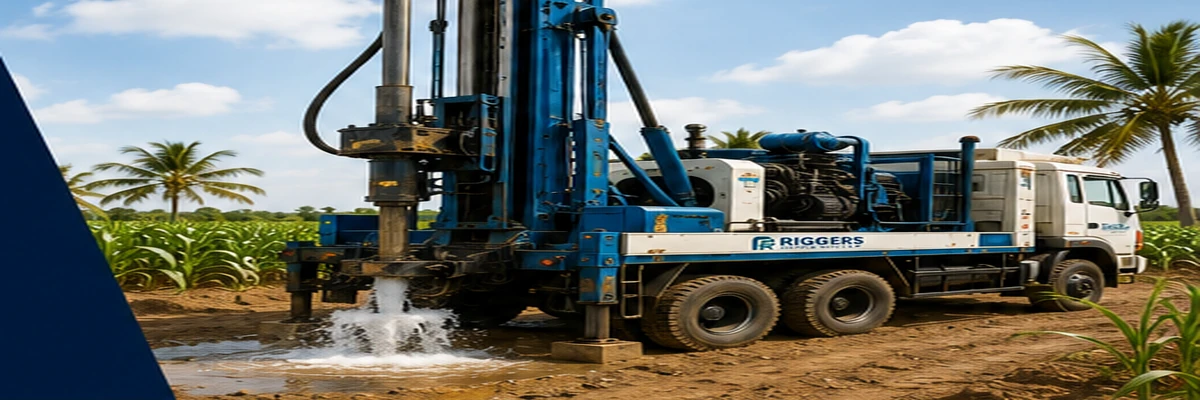
Specify the borewell around the application, not the catalogue.
An orchard, open field, greenhouse, dairy farm and a multi-farm irrigation contract can present very different conditions. Access width, terrain, crop water needs, likely geology, bore diameter and seasonal workload all change the right equipment.
Site information should come before machine selection. A drilling rig cannot guarantee that groundwater will be found or that a finished borewell will give a particular yield, so local subsurface evidence matters.
Define the borehole
Target depth, finished diameter, likely overburden, casing and expected formation.
Define the worksite
Approach-road width, field conditions, turning space, gradients, utilities and set-up area.
Define the duty
Annual workload, moves per season, mounting, compressor or mud pump, rod handling and service needs.
Where farm borewell rigs go to work.
Select the drilling package around the bore construction and site, not the crop name alone.
Field and crop irrigation
A primary water source or a supplement to rainfall, tanks and canals. Match the rig to the formation, depth and bore design.

Orchards, nurseries and protected crops
Permanent and high-value crops need dependable water over long periods; plan borewell, pump, storage and irrigation together.

Greenhouses and nurseries
Smaller, accessible sites often suit a tractor-mounted rig that can move between plots.

Drip and sprinkler systems
Pump selection follows the tested water level and yield, not drilled depth alone.


Contractors and rural water
Contractors moving between farms weigh transport, set-up time, rod handling and spares as much as depth.
Match the drilling method to the ground.
Method, compressor or mud pump, hammer, bit and drill string must work as one system.
DTH for hard rock
Down-the-hole drilling advances through competent or fractured rock using compressed air. Compressor, hammer and bit are chosen together.
DTH rigsRotary for loose formations
Soft soil, sand, clay and alluvium usually need rotary drilling with fluid circulation, and an early casing plan.
Rotary rigsDTH-cum-rotary for mixed strata
Many farm bores start in soil, pass through weathered rock and end in hard rock. A dual-method rig handles the change.
DTHR-300Choose a mounting that fits the farm.
Tractor-mounted borewell rigs
Suits farms where moving between field locations matters and depth and diameter stay within the rig’s rating. Published example: TBW 40, 4.5–6.5 in holes to 500 ft.
TBW 40Truck-mounted borewell rigs
Carries larger compressors, mud pumps, tool storage and rod handling for professional contractors and deeper wells: DTHR-300, DTHR-600, DTH-1500.
Truck rigsCrawler and custom configurations
Narrow farm gates, slopes, remote fields or transport limits may need a crawler, skid or special mounting. Tell us early.
Crawler rigsPublished models for farm borewells.
A starting shortlist for an engineering discussion, not a final recommendation.
| Model | Configuration | Published depth | Formation range | Good starting point for |
|---|---|---|---|---|
| TBW 40 | Tractor-mounted water-well rig | 500 ft | Soft and hard rock | Field mobility, moderate depth |
| DTHR-300 | Truck DTH-cum-rotary rig | 300 m | Soft, hard, unconsolidated, alluvial | Mixed formations |
| DTHR-600 | Truck or deck-engine DTH-cum-rotary | 600 m | Soft, hard, unconsolidated, alluvial | High-capacity and deep wells |
| DTH-1500 | Heavy-duty truck DTH rig | 1,500 ft | Soft and hard rock | Deep hard-rock borewells |
Eight inputs that define the right farm rig.
Geological formation
Alluvial, sandy, clay-rich, weathered, fractured or competent rock.
Depth and diameter
Target depth and finished diameter, with casing and drilling tools.
Overburden and casing
Expected overburden depth, starting hole size and casing sizes.
Air or mud system
Compressor or mud pump matched to bit, hammer, diameter and depth.
Feed and rod handling
Drill-string weight, rod length, pull-up, pull-down and breakout.
Mounting and access
Road width, turning space, terrain, set-up area and utilities.
Duty and service
Operating hours, moves, climate, tool use and spares planning.
Destination
For export: country, chassis, engine, transport limits and documents.
A practical farm borewell sequence.
Define the water requirement
Intended use, irrigated area, season, storage and irrigation method.
Review the site and subsurface
Hydrogeological information, nearby bore records and water levels.
Prepare the rig specification
Formation, depth, diameter, casing, method, access and destination.
Plan safe set-up
Access, clearance, levelling, powerlines, buried services and exclusion zones.
Drill and keep a bore log
Formations, water-bearing zones, casing and completion details.
Test, then select the pump
Use a yield test and tested water level, not drilled depth, to choose the pump.
Groundwater and safety
Plan the borewell as part of a managed water system: confirm local permissions and siting, keep the bore record, test the well, monitor water levels and use efficient irrigation.
Drilling involves mobile plant, rotating equipment, hydraulics, high-pressure air, noise and dust. Only trained people should operate and maintain the rig, after a site-specific risk assessment.
Presence, depth, quality and yield of groundwater depend on local hydrogeology. No rig or drilling method can guarantee them.
Frequently asked questions
What type of borewell rig is best for agricultural use?
There is no single best rig. The right configuration depends on geology, target depth, finished diameter, overburden, casing, access, drilling method and workload. A tractor-mounted rig may suit one farm; a truck-mounted DTH-cum-rotary rig another.
Is DTH or rotary drilling better for a farm borewell?
DTH is usually chosen for competent rock. Rotary is often needed in soft, loose or alluvial ground. Where the bore passes through changing strata, a DTH-cum-rotary rig gives useful flexibility.
Is a tractor-mounted rig suitable for farm borewells?
It can be, if its diameter, depth, formation and compressor ratings match the project. The TBW 40 is published for 4.5 to 6.5 inch holes to 500 ft in soft or hard rock.
How deep should an agricultural borewell be?
There is no standard depth. It depends on the aquifer, local geology, seasonal water levels and location. Nearby bore records help but cannot guarantee conditions at a new point.
Can a rig guarantee that water will be found?
No. A rig builds the borehole; it cannot guarantee the presence, depth, quality or yield of groundwater. Good hydrogeological assessment improves the decision but cannot remove the uncertainty.
Can one rig drill through loose soil and hard rock?
A DTH-cum-rotary rig can. The DTHR models are published for soft, hard, unconsolidated and alluvial formations, with tooling chosen for the strata met.
Should the pump be selected before drilling?
Estimate it during planning, but choose the final pump from the finished well’s tested water level, drawdown, yield and diameter.
What information is needed for a quotation?
Location, target depth, bore diameter, expected formation, overburden and casing, mounting preference, site access, compressor or mud-pump needs, preferred chassis, workload and destination country.
Still deciding?
Send the depth, diameter, formation and site details you have. The team will reply with the configurations worth discussing.
Related equipment
Agricultural borehole contracting.
Water well & borewellBorewell Drilling RigsDTH, rotary, truck, tractor and crawler options.
Water well & borewellWater Well Drilling RigsTruck and tractor rigs from 100 m to 600 m.
Water well & borewellDTH Borehole Drilling RigsCompressed-air hammer drilling for hard rock.
Water well & borewellRotary Borehole Drilling RigsSoil, clay, alluvium and mixed strata.
Tell us about the hole you need to drill.
Share the depth, diameter, formation and site access you know. The team will come back with the rig, tooling and package worth discussing.