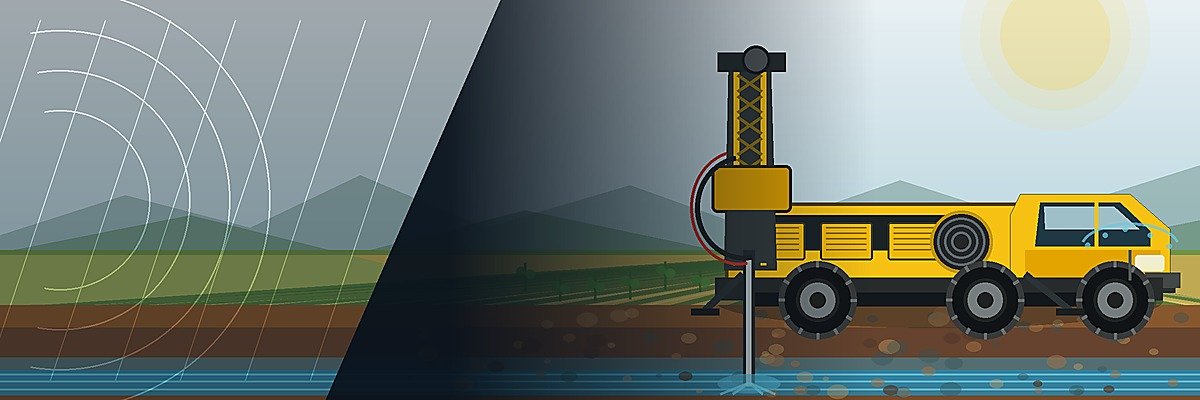
Agricultural water-well solutions
Borewell Rigs for Agricultural Applications
Select a borewell rig around the geology, target depth, finished diameter, casing plan, field access and drilling method - not maximum depth alone.
Riggers International manufactures tractor-mounted, truck-mounted DTH and DTH-cum-rotary water-well rigs for agricultural, commercial and rural water-development requirements in India and export markets.
- 01Ground formation
- 02Target depth
- 03Bore diameter
- 04Site access
Selection principle
Specify the Borewell Around the Application - Not the Catalogue
An orchard, open field, greenhouse, dairy farm and multi-farm irrigation project can present very different operating conditions. Access width, terrain, crop-water requirements, anticipated geology, bore diameter and seasonal workload all influence the appropriate equipment configuration.
Engineering note
Site information should come before machine selection.
The Central Ground Water Board's aquifer-mapping approach combines geological, geophysical, hydrogeological, hydrological and water-quality studies. This illustrates why borewell planning should be based on local subsurface evidence rather than assumptions alone. A drilling rig cannot guarantee that groundwater will be encountered or that a completed borewell will produce a particular yield.
Define the Borehole
Set the target depth, finished diameter, likely overburden, casing requirement and anticipated formation before discussing a rig model.
Define the Worksite
Confirm approach-road width, field conditions, turning space, ground bearing capacity, gradients, utilities and the clear area available for safe setup.
Define the Duty
Consider annual workload, relocation frequency, preferred mounting platform, compressor or mud-pump arrangement, rod handling and local service needs.
Agricultural use cases
Where Agricultural Borewell Rigs Go to Work
The drilling package should be selected around the bore construction and site conditions. The crop name alone is not a sufficient equipment specification.
Field and Crop Irrigation
A borewell may serve as a primary water source or supplement rainfall, tanks, canals and other surface-water supplies. Match the rig to the expected formation, depth and bore construction.
Orchards, Nurseries and Protected Crops
Permanent and high-value crops often require planned water delivery over long periods. The borewell, pump, storage and irrigation system should be evaluated as an integrated system.
Livestock and General Farm Water
Agricultural borewells may support livestock watering, equipment cleaning, storage tanks and other farm activities. Water quality and treatment needs must be assessed separately for the intended use.
Contractors and Rural Water Projects
Contractors moving between sites should consider transportability, setup time, rod handling, compressor compatibility, tooling, spare-parts planning and operator familiarity alongside depth capacity.
FAO highlights groundwater monitoring, efficient irrigation, water harvesting and better water management as important measures for agricultural water security.
Read the FAO overview (opens in a new tab)
Formation-led selection
Match the Drilling Method to the Ground Formation
The selected method, compressor or mud pump, hammer, bit and drill string must operate as a compatible system.
DTH Drilling for Hard-Rock Conditions
Down-the-Hole drilling is commonly considered where a bore must advance through competent or fractured rock using compressed air.
- Hard or fractured rock formations
- Deeper agricultural water-well construction
- Controlled borehole advancement
- Air compressor, hammer and bit selected together
Rotary Drilling for Loose Formations
Rotary capability is often required in soft soil, loose overburden, alluvial material and other unconsolidated formations.
- Soft, sandy, clay-rich or alluvial strata
- Drilling-fluid circulation where appropriate
- Mud-pump and casing plan considered early
- Bore stability monitored during construction
DTH-Cum-Rotary for Mixed Strata
A bore may begin in soil or alluvium, pass through weathered material and then enter competent rock. A dual-method rig can provide flexibility where formation changes are expected.
- Rotary drilling through loose upper strata
- DTH drilling after entering rock
- Overburden and reaming requirements
- Tooling changed to suit actual conditions
Explore Riggers International borewell drilling configurations
Mobility and access
Choose a Mounting Platform That Fits the Site
A machine is not suitable merely because it can reach the target depth. It must also reach, level and operate safely at the bore point.
Field mobility
Tractor-Mounted Borewell Rigs
A tractor-mounted arrangement can suit agricultural sites where movement between field locations is important and the required depth and diameter remain within the engineered capacity.
Published example: TBW 40 - 4.5 to 6.5 in boreholes, up to 500 ft, for soft or hard rock.
Higher-capacity package
Truck-Mounted Borewell Rigs
Truck-mounted configurations can accommodate larger drilling packages, compressors, mud pumps, tool storage and rod-handling equipment for professional contractors and deeper projects.
Published examples include the DTHR-300, DTHR-600 and DTH-1500.
Constrained sites
Portable, Crawler and Custom Configurations
Narrow farm entrances, sloping terrain, remote locations or unusual transport limits may require a compact, crawler, skid or other application-specific mounting arrangement.
Share site access, terrain and destination-market constraints at the beginning of the enquiry.
Initial model evaluation
Published Riggers International Models for Agricultural Projects
This shortlist is intended to begin an engineering discussion. It is not a final model recommendation, and the published maximum depth should never be treated as the only selection criterion.
| Model | Published configuration | Published maximum depth | Published formation range | Potential agricultural starting point |
|---|---|---|---|---|
| TBW 40 | Tractor-mounted water-well rig | 500 ft | Soft and hard rock | Field mobility and moderate-depth borewell projects |
| DTHR-300 | Truck-mounted DTH-cum-rotary rig | 300 m | Soft, hard, unconsolidated and alluvial | Mixed formations requiring rotary and DTH capability |
| DTHR-600 | Truck or deck-engine DTH-cum-rotary rig | 600 m | Soft, hard, unconsolidated and alluvial | Higher-capacity and deep water-well projects |
| DTH-1500 | Heavy-duty truck-mounted DTH rig | 1,500 ft | Soft and hard rock | Deep borewell projects requiring a truck-mounted DTH package |
Published values summarise information on Riggers International product pages at the time this content package was prepared. Actual achievable depth, penetration rate, fuel use, bore diameter and output depend on final configuration, geology, tooling, compressor performance, operator practice and site conditions. Confirm all specifications in the technical quotation.
Engineering checklist
What Defines the Right Agricultural Borewell Rig?
Use these eight inputs to move from a broad equipment enquiry to an application-matched technical discussion.
Geological Formation
Identify alluvial, sandy, clay-rich, weathered, fractured or competent rock conditions using the best available evidence.
Depth and Diameter
Define target depth and finished diameter together with the casing, drilling tool, circulation system and anticipated formation.
Overburden and Casing
Include expected overburden depth, initial hole size and proposed casing sizes in the equipment enquiry.
Air or Mud System
Match the compressor or mud pump to the bit, hammer, hole diameter, depth, circulation requirement and formation.
Feed and Rod Handling
Review drill-string weight, rod length, pull-up, pull-down, mast design, breakout arrangements and handling method.
Mounting and Access
Provide road width, turning space, terrain, setup area, ground conditions and overhead or underground utility constraints.
Duty and Serviceability
Discuss operating hours, relocation frequency, climate, tool consumption, preventive maintenance and spare-parts planning.
Destination Requirements
For export, share the country, preferred chassis, engine expectations, transport limits, ambient conditions and documentation needs.
Why Riggers International
Application Conversations Backed by a Broad Drilling Range
Drilling-equipment experience
The company describes more than three decades of experience across water-well, core, mining, piling and specialised drilling equipment.
Water-well rig configurations
The published range includes tractor-mounted, truck-mounted DTH and DTH-cum-rotary equipment for different depths and formations.
Supporting components
Riggers International also lists hammers and bits, drill rods, accessories and hydraulic spares.
Manufacturing support
The company identifies its corporate office and factory in Tiruchengode, Tamil Nadu, and serves Indian and overseas enquiries.
Project workflow
A Practical Agricultural Borewell Project Sequence
Equipment selection is one stage in a broader process that also covers hydrogeological review, safe mobilisation, bore records, testing and irrigation-system integration.
-
01
Define the Water Requirement
Document the intended use, irrigated area, operating season, storage arrangement and irrigation method. This informs planning but does not prove that the aquifer can supply the requested volume.
-
02
Review the Site and Subsurface
Use available hydrogeological information, nearby bore records, groundwater-level data and, where appropriate, geophysical investigation to develop an initial drilling plan.
-
03
Prepare the Rig Specification
Share the expected formation, target depth, diameter, casing plan, drilling method, site access and destination requirements. Review the rig, air or mud system, rods, hammer and bits together.
-
04
Plan Mobilisation and Safe Setup
Confirm access, working clearance, bearing conditions, levelling, stabiliser placement, powerlines, underground services, public exclusion and environmental controls before drilling begins.
-
05
Drill and Maintain a Bore Record
Record formations encountered, depth changes, water-bearing zones, drilling response, casing installation and final completion details to support future operation and maintenance.
-
06
Test the Completed Borewell
A suitable pumping or yield test helps assess the completed well and informs sustainable pumping and pump selection. Review CGWB pumping-test information (opens in a new tab).
-
07
Integrate the Pump and Irrigation System
Select the pump, controls, delivery pipe, storage and irrigation equipment using the tested water level and bore performance - not drilled depth alone.
Responsible delivery
Groundwater Stewardship and Drilling Safety
Groundwater
Plan for Sustainable Use
An agricultural borewell should form part of a managed water system rather than encourage uncontrolled abstraction. Confirm local permissions and siting requirements, retain the bore record, test the well, monitor water levels and use efficient irrigation appropriate to the crop and soil.
- Confirm applicable permissions and restrictions
- Record water levels and abstraction over time
- Use storage and irrigation scheduling to reduce waste
- Review pumping practice if drawdown increases
Groundwater disclaimer: Presence, depth, quality and yield depend on local hydrogeology. Equipment selection and drilling cannot guarantee water discovery or a particular discharge.
Safety
Control Mobile-Plant and Drilling Hazards
Borewell drilling involves mobile plant, rotating equipment, hydraulics, suspended loads, high-pressure air, noise, dust and changing ground conditions. Only trained and authorised personnel should operate or maintain the equipment.
- Complete a site-specific risk assessment and exclusion plan
- Set up on stable ground with suitable levelling and stabilisation
- Inspect hydraulic and high-pressure air lines before operation
- Use safe rod handling, guarding, PPE and isolation procedures
- Check overhead powerlines and underground services
Review OSHA drilling-related hazard guidance (opens in a new tab)
Buyer questions
Frequently Asked Questions
What type of borewell rig is best for agricultural use?
There is no single best rig for every agricultural borewell. The appropriate configuration depends on geology, target depth, finished diameter, overburden, casing requirements, access, drilling method and expected workload. A tractor-mounted rig may suit one farm, while a truck-mounted DTH-cum-rotary machine may be more appropriate for another.
Is DTH or rotary drilling better for an agricultural borewell?
DTH drilling is commonly considered for competent rock. Rotary capability is often required in soft, loose, unconsolidated or alluvial formations. Where the bore is expected to pass through changing strata, a DTH-cum-rotary rig may provide useful flexibility. Final method selection should be based on actual site conditions and professional drilling advice.
Is a tractor-mounted rig suitable for farm borewells?
It can be, provided the machine's diameter, depth, formation and compressor capabilities match the project. Riggers International publishes the TBW 40 for 4.5 to 6.5 in boreholes, with a stated maximum depth of 500 ft in soft or hard rock. Confirm suitability for the actual site before ordering.
How deep should an agricultural borewell be?
There is no standard depth for every farm. Required depth varies with the aquifer, local geology, seasonal groundwater levels and bore location. Nearby bore records provide context but cannot guarantee conditions at a new drilling point.
Can a borewell rig guarantee that water will be found?
No. A rig constructs the borehole; it cannot guarantee the presence, depth, quality or yield of groundwater. Hydrogeological assessment and responsible site selection can improve the drilling decision but cannot remove subsurface uncertainty.
Can one rig drill through loose soil and hard rock?
A suitably configured DTH-cum-rotary rig may address both rotary and DTH requirements. Riggers International publishes DTHR models for soft, hard, unconsolidated and alluvial formations, although tooling and procedures must still be selected for the strata encountered.
What information is needed to request a quotation?
Provide the project location, target depth, required bore diameter, anticipated formation, overburden and casing details, mounting preference, site access, compressor or mud-pump requirement, preferred chassis, expected workload and destination country.
Should the pump be selected before drilling?
A preliminary pumping requirement may be estimated during planning, but final pump selection should use the completed borewell's tested water level, drawdown, yield, diameter and intended irrigation duty. Selecting only by total drilled depth can produce an unsuitable pumping system.
What should be done after the borewell is completed?
Maintain a bore log, complete appropriate well development, conduct a pumping or yield test, assess water quality for its intended use, select the pump from the test results and establish a monitoring and maintenance plan.
Application review
Specify Your Agricultural Borewell Rig
Send the project information below so the Riggers International team can narrow the available models and prepare a configuration for technical and commercial review.
- Project location and destination country
- Agricultural application and expected duty
- Anticipated soil or rock formation
- Target depth, bore and casing diameters
- Mounting, access and terrain requirements
- Compressor, mud-pump and tooling needs
Technical content note: Prepared for Riggers International using the company's published water-well rig information and cited groundwater and safety sources. Final machine configuration, specifications, tooling and commercial terms must be confirmed by the Riggers International engineering or sales team before purchase.
Borehole applications
Borewell rigs
Contact Riggers International