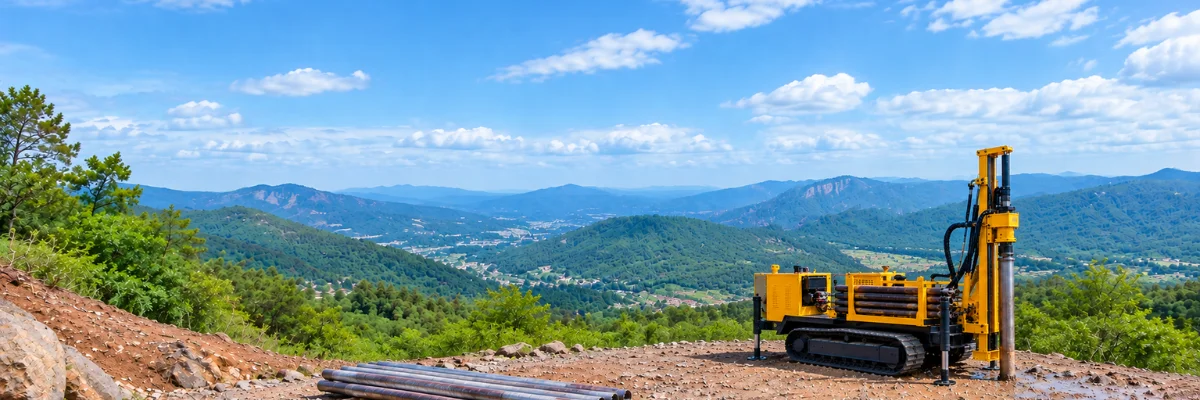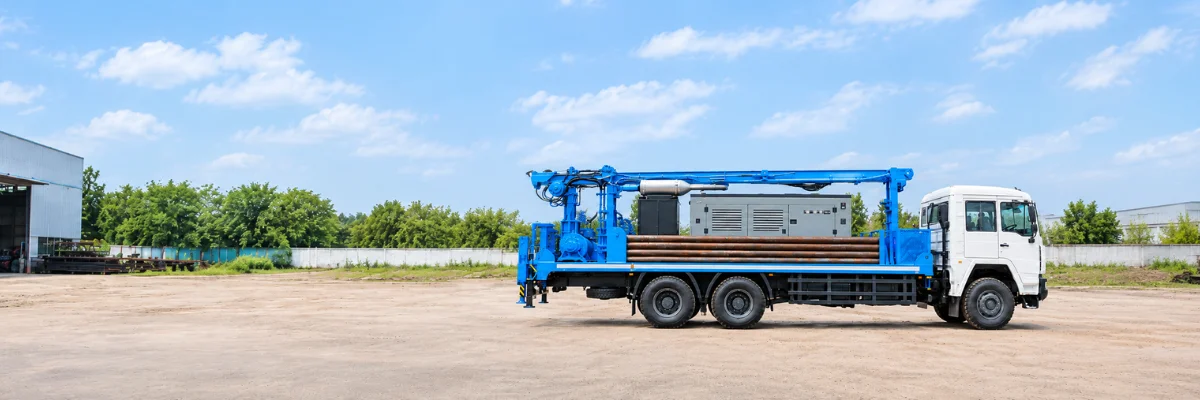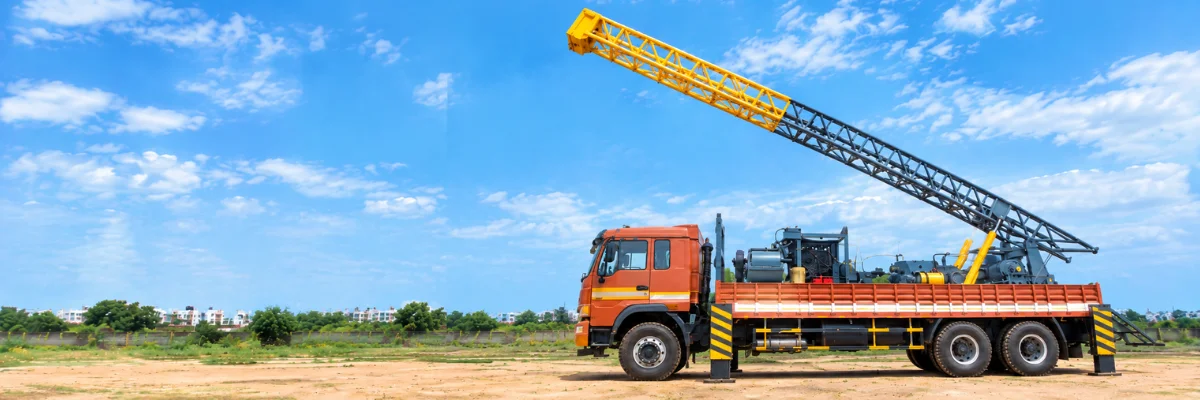
- DTH: percussion at the bit, compressed air, best in hard rock.
- Rotary: rotation and weight, usually mud circulation, best in soft and unconsolidated ground.
- Mixed strata: a DTH-cum-rotary rig changes method with the ground.
How DTH drilling works
A pneumatic hammer sits directly behind the bit at the bottom of the hole. Compressed air drives the piston, which strikes the bit many times a second while the rig rotates the string slowly. The same air flushes cuttings up the hole.
Because the impact is delivered at the bottom, energy is not lost along the rod string. DTH holes tend to be straight and penetration stays high in hard rock.
How rotary drilling works
Rotary drilling turns a bit, often a tricone rock roller, under weight. Teeth or inserts crush and scrape the formation. Drilling fluid, usually mud, is pumped down the rods to cool the bit, lift cuttings and support the hole wall.
Rotary is well suited to soil, sand, clay and alluvium, where a DTH hammer would struggle to keep the hole open and clean.
Where each method works best
Choose DTH for granite, basalt, quartzite and other competent rock, and for fractured rock where air flushing is effective.
Choose rotary for thick overburden, sands and clays, and where hole stability depends on mud.
When the ground changes with depth, a combination rig avoids a second machine.
Equipment each method needs
DTH needs a compressor sized for the hammer, hole size and depth, plus hammers, button bits and rods. Water inflow and depth increase the pressure needed.
Rotary needs a mud pump, mud mixing and handling, rock roller or drag bits, and rods sized for the annulus.
When to choose a DTH-cum-rotary rig
Our DTHR-100, DTHR-300 and DTHR-600 are published for soft, hard, unconsolidated and alluvial formations. They carry both a mud pump and DTH capability, so a borewell can be started with rotary through overburden and finished with DTH in rock.
Questions
Is DTH faster than rotary?
In hard rock, usually yes. In soft or loose ground, rotary with mud is often faster and keeps the hole stable.
Can I use DTH in sand?
It is difficult: the hole can collapse and air may not lift cuttings well. Rotary with mud, or casing through the sand before switching to DTH, is the usual approach.
Do I need two rigs for mixed ground?
Not necessarily. A DTH-cum-rotary rig handles both methods on one carrier.